
Regenerative Medicine
Platelet-Rich Plasma Injections in North Phoenix
Ultrasound-guided PRP uses concentrated platelets from your own blood to support healing in joints, tendons, and ligaments: a regenerative option for people tired of injections that simply wear off.
Healing support, not another quick fix
If you have been told your only options are to manage the pain, repeat injections, or eventually consider surgery, PRP offers a different path. Traditional injections aim to block inflammation or pain signals for a while. PRP is aimed at the reason the tissue is not healing in the first place.
PRP is not a "quick gimmick" or a masking strategy. It's a biologic approach that uses your own blood components to stimulate a healing response in tissues that aren't recovering properly on their own. PRP is positioned differently:
- Long-lasting approach: PRP is intended to support healing rather than "wear off."
- Root-cause focus: helps target injured tissues that are not healing appropriately.
- Uses your own biology: PRP is derived from your own blood and then concentrated.
- Precision matters: injections are performed with image guidance when needed to ensure accuracy.
Effectiveness depends on the severity and nature of the injury, as with any treatment. That's why the evaluation matters.
Platelet-Rich Plasma is made from a small sample of your own blood, concentrated so the platelets (the cells central to your body's natural repair process) are delivered directly into the injured structure. Because it comes from your own body, there is no risk of allergic reaction. Depending on the severity and location of the injury, PRP may help some patients delay or avoid joint replacement, though every case is different, and no ethical provider guarantees results.
How PRP is made and placed
The full preparation takes about 25 to 30 minutes during an ordinary office visit. A small amount of blood is drawn, just like a routine lab test, then spun in a centrifuge that separates it into layers. The red cells are discarded, and the concentrated platelet-rich portion is collected for injection. Start to finish, including the injection itself, the visit typically takes less than an hour.
PRP may be injected into the specific structure that has been identified as a pain generator or tissue that is not healing appropriately, such as tendons, ligaments, muscles, and joints.
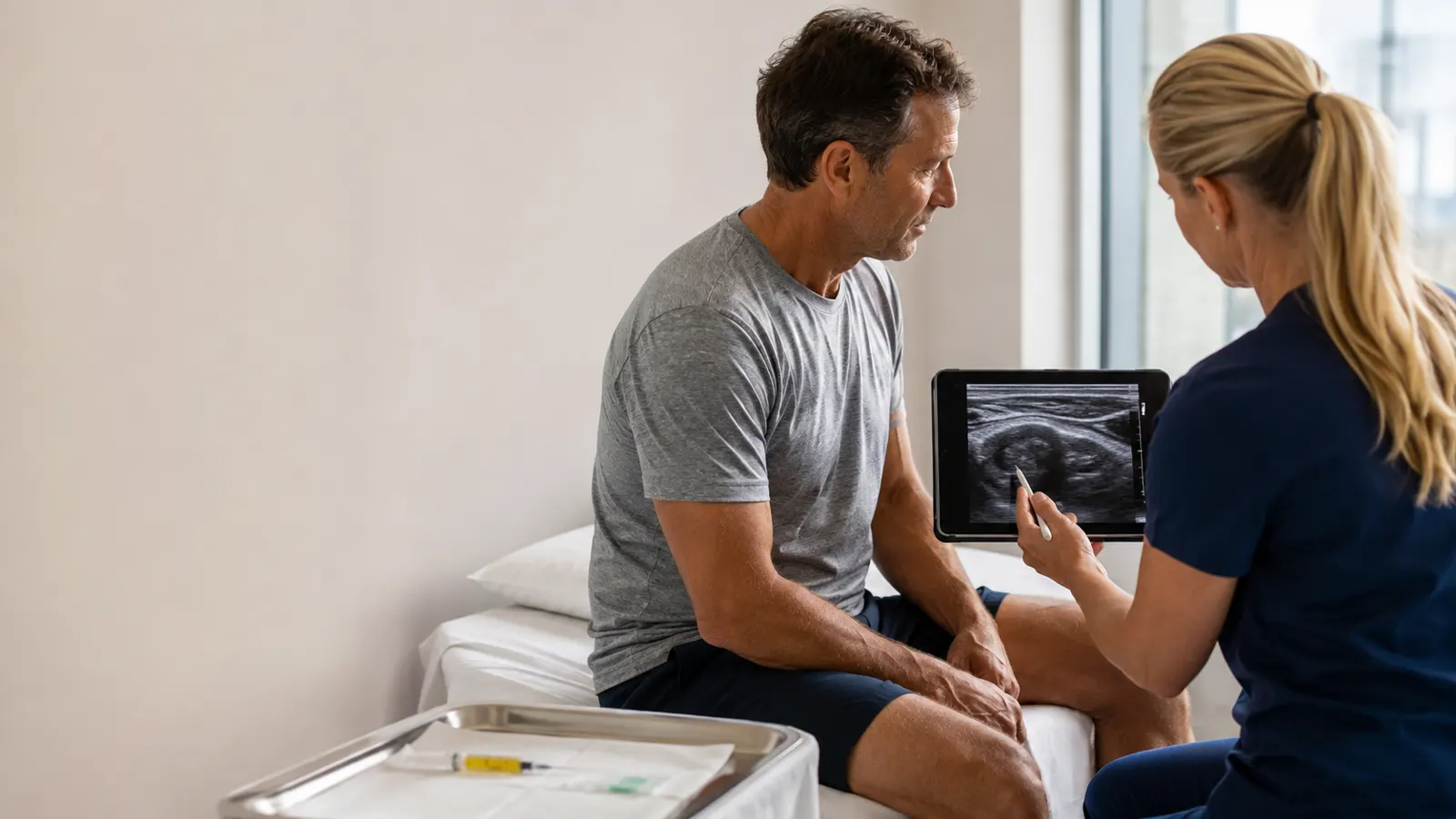
Placement is everything. For shoulders, elbows, wrists, hips, knees, and ankles, we use ultrasound guidance to place the PRP precisely into the injured tendon, ligament, or joint, giving it the best possible chance to help.
Who PRP Helps
Common reasons patients choose PRP
Most candidates are simply active people (hikers, lifters, workers) whose pain started small and never fully resolved.
Knee Pain
Our most common and best-responding PRP target, including early osteoarthritis and soft-tissue injury.
Learn moreShoulder Pain
Rotator cuff irritation and chronic shoulder injuries that flare with activity.
Learn moreElbow Pain
Stubborn tendon injuries such as tennis and golfer's elbow.
Learn moreHip Pain
Tendon and joint irritation that has not settled with rest or standard care.
Learn moreFoot & Ankle Pain
Chronic soft-tissue injuries that keep interrupting daily miles.
Learn moreSports Injuries
Overuse injuries in athletes who want to keep training, not just keep resting.
Learn moreIn Phoenix, we see many people whose pain started as "minor" and then gradually became constant, especially after long workdays, weekend projects, or staying active outdoors. For some, it's a knee that never fully recovered. For others, it's an elbow, shoulder, hip, ankle, or a stubborn pain pattern that keeps returning no matter what they try.
Many PRP candidates aren't "injury-prone." They're just active people who live full lives, and pain starts interrupting that. PRP is frequently chosen by people who want to keep training, keep working, keep walking, and keep living, without the cycle of temporary relief and repeated flare-ups.
Patients often seek PRP here because they want:
- A non-surgical solution aimed at healing
- A path that may reduce the need for repeat injections
- A plan based on clinical evaluation, not guesswork
- Image-guided precision when appropriate
- A clear explanation of what is happening and why
Pricing, expectations, and aftercare
PRP knee injections are $700 for one knee and $900 for both knees, cash. Insurance rarely covers PRP, so we keep pricing simple and transparent. Plans typically involve 2 to 6 injections over time, and many patients notice meaningful improvement after the first or second.
One instruction matters more than any other: avoid anti-inflammatory medications such as Aleve, Motrin, Celebrex, Naprosyn, and Mobic after your injection. They can blunt the very healing response PRP is designed to trigger. You will leave with clear aftercare guidance, and tissues with richer blood supply, knees and shoulders especially, tend to respond best. Sooner is better: the longer a degenerative issue waits, the more results vary.
What to expect from a PRP consultation
A high-quality PRP plan starts with clarity. Your first step should be an evaluation that confirms:
- What tissue is actually injured
- Whether the structure is likely to respond to PRP
- Whether PRP should be combined with other supportive care
- How many sessions are reasonable based on severity and goals
PRP is not the answer for every condition. The point of an expert consultation is to determine whether it makes sense for you, and to set realistic expectations.
Wondering if PRP fits your case? Start with an evaluation, browse our FAQ, or see our new patient specials.
Common Questions
PRP injection FAQs
What is a PRP injection?
PRP (platelet-rich plasma) is made by drawing a small sample of your own blood and spinning it in a centrifuge to concentrate the platelets, the cells central to natural tissue repair. That concentrate is then injected precisely into the injured joint, tendon, or ligament under ultrasound guidance to support healing at the source.
Are PRP injections painful?
Most patients compare the discomfort to an ordinary blood draw: the needle stick is the only sharp moment, and the area is numbed first. Mild soreness or tightness can follow for a few days as the healing response begins, then settles. Most patients like our bee sting pain scale and tell us it's a 1 or 2 bee stings out of five.
How many PRP injections will I need?
Plans typically involve 2 to 6 injections depending on the tissue involved, how long it has been injured, and how you respond. Many patients notice meaningful improvement after the first or second injection. Your plan is based on your case, not a one-size-fits-all package.
How much do PRP injections cost in North Phoenix?
Knee PRP is $700 for one knee and $900 for both knees, paid in cash. Insurance rarely covers PRP, so we keep pricing transparent with no hidden fees, and the consultation will tell you honestly whether PRP is worth pursuing for your injury.
What should I avoid after a PRP injection?
Avoid anti-inflammatory medications such as Aleve, Motrin, Celebrex, Naprosyn, and Mobic, because they can interfere with the healing response PRP is meant to stimulate. Take it easy for a day or two, skip strenuous activity for about a week, and follow the aftercare plan we send home with you.
How soon will I see results from PRP?
Early improvement often appears within 2 to 4 weeks, with benefits building over 6 to 12 weeks as tissue regenerates. Results vary with the severity of the damage and the blood supply of the injured tissue (knees and shoulders tend to respond best), and no honest provider can guarantee a specific outcome.
Can I get the PRP injection the same day as my exam?
If you and your doctor agree on treatment, you can receive the injection the same day as your examination.
Is there downtime after PRP injections?
Minimal downtime follows PRP. Most PRP injection recipients resume light activities the same day, and full daily activities of normal everyday tasks in 48 hours. We advise tailored rest and progressive exercises to complete your rehabilitation journey. Every patient recovers a little differently.
Is PRP better than cortisone?
We really don't state that PRP is better than cortisone, because they have very different chemical and physiological pathways. Cortisone injections are primarily prescribed to decrease inflammation and pain, whereas PRP decreases pain and inflammation by helping heal the tissues that are causing the inflammation. For that reason, PRP results generally last longer than cortisone injections. Cortisone is more anti-inflammatory, whereas PRP is more of a healing treatment.
Can PRP treat tendon injuries?
Yes, PRP can treat tendon injuries like tennis elbow by delivering growth factors for repair. Please note PRP is not a fountain of youth, and all results vary depending on how much damage is present at the time you initiate treatment. When discussing soft tissue injuries, there is a medical adage that states broken bones sometimes heal better and faster than tendon injuries. This has to do with how much blood flow that specific type of soft tissue has. For instance, muscle tissue has a great blood supply and heals better and faster than ligament or tendon injuries. Blood flow is less in ligaments, and tendons are lowest on the totem pole, with even less blood flow than ligaments. The best results we see are in knees and shoulders, with knee injections yielding the best results between the two.
Does insurance cover PRP, and can I finance it?
More often than not, insurance does not cover PRP injection therapy. We have an established relationship with CareCredit, but they are a third party and we do not guarantee that they will finance your PRP procedure. PRP is a cash-only procedure at this time.
Do you guarantee PRP results?
No. No ethical medical or chiropractic physician can guarantee results, and we never guarantee results. We do guarantee you will be treated like one of our longstanding practice members, with dignity and respect, and we will be as honest as the day is long about the results you can expect following a full consult and exam.
Keep Reading
Is PRP right for you?
Begin Your Path to Relief
Your first visit starts here
Full consultation, examination, X-rays if necessary, and your first adjustment: $79 for new patients. Serving Moon Valley and North Phoenix with care, integrity, and heart.